A compiler doesn't translate source into just one thing. Once you see the Helm chart as an abstract syntax tree, the whole pattern falls into place.
Application-Driven Infrastructure — a four-part series:
Part 1: Your Helm Chart Already Knows More Than Terraform Does · Part 2: Generating Terraform from Helm · Part 3: Building a Self-Describing Platform · Part 4: Your Helm Chart Is Really an Abstract Syntax Tree
A compiler doesn’t translate source code into just one thing.
That’s the detail people forget. A compiler parses source into a structured representation of meaning, and from that representation it can emit whatever a target needs — machine code for this architecture, machine code for that one, debug symbols, optimization reports. One source of meaning, many outputs. Nobody finds this controversial. Nobody maintains a separate hand-written copy of their program for each CPU.
And yet that’s exactly how most platforms treat their services: one hand-maintained description for Kubernetes, another for Terraform, another for the dashboard tool, another for the catalog, another for the wiki. Over the last three articles we’ve been dismantling that arrangement — first naming the drift problem, then generating Terraform from a Helm chart, then generating the rest of the operational surface. This final article is about why the pattern works, and the answer is a reframe I find genuinely fun: your Helm chart was never just a pile of Kubernetes templates. It’s an abstract syntax tree for your platform, and once you see it that way, the whole architecture snaps into focus.
More Than a YAML Generator
Ask most teams what Helm does and you’ll get some version of this — values.yaml + templates → Kubernetes YAML. True, but it undersells the machinery. What Helm actually implements is something closer to a compiler:
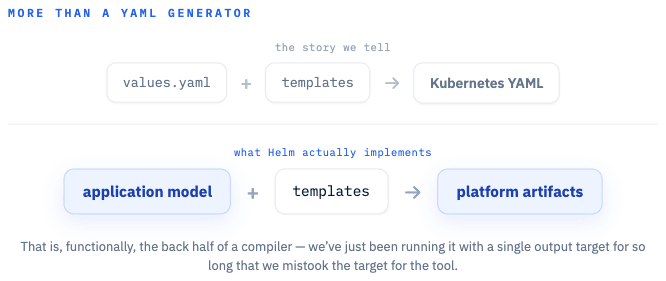
The reframe: Helm isn’t a YAML generator locked to one output — it’s an application model plus templates that can emit many kinds of platform artifact.
Those artifacts can be Kubernetes YAML — historically they always have been — but as we proved in Part 2, nothing about the engine cares. Helm parses a structured model, walks templates against it, and emits text. That is, functionally, the back half of a compiler. We’ve just been running it with a single output target for so long that we mistook the target for the tool.
The Chart as an AST
Here’s a quick refresher for anyone who hasn’t thought about compilers since college: an abstract syntax tree is the structured representation a compiler builds after parsing your source code. It captures what the program means — the declarations, the relationships, the intent — stripped of surface syntax, so the rest of the toolchain can work with meaning instead of characters.
Now look at what a well-built Helm chart contains: workloads, services, ports, labels, probes, ingress rules, runtime configuration, environment overrides, ownership metadata, observability intent, deployment assumptions. That’s not a bag of YAML fragments. That’s a structured, hierarchical description of what an application is — its declarations, relationships, and intent.
In other words: it’s an application AST. The chart holds the meaning; everything downstream is just syntax for some particular target.
Values as Source Code
Follow the metaphor one level down and values.yaml becomes the source code of your platform:
service:
  name: wallet
  tier: critical
  port: 8080

health:
  path: /version

owner:
  team: payments

observability:
  alerts: true
  dashboards: true
  synthetics: true
Look at how declarative that is. It doesn’t say how to build a dashboard or which API creates a synthetic monitor. It states facts and intent — this service exists, it’s critical, it’s owned by payments, it should be watched. Deciding what those declarations compile to is somebody else’s job. Which brings us to the templates.
Templates as Backends
In compiler terms, each template is a backend — a code generator that lowers the shared source model into one target’s concrete format:
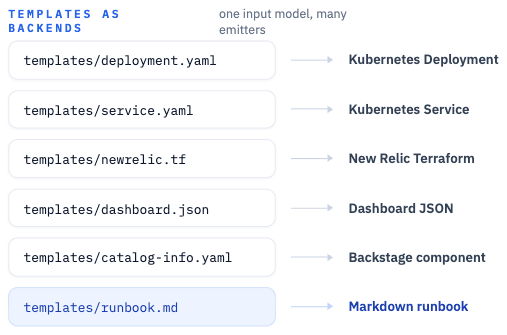
Templates as backends: one input model, many emitters — Kubernetes, Terraform, dashboards, catalog, and docs each get their own backend template.
One input model, many emitters. This is the same trick LLVM pulled on the compiler world: agree on one intermediate representation, and suddenly every language front end can reach every hardware back end without anyone writing N×M translators. Your platform has the same shape. The service model is the intermediate representation; Kubernetes, Terraform, Grafana, Backstage, and Markdown are the targets. Adding a new target — say, your org adopts a new incident tool — means writing one new backend template, not re-describing every service by hand.
Why the Metaphor Earns Its Keep
I want to be honest about something: engineers reach for grand metaphors all the time, and most of them are decoration. This one isn’t, and here’s the test — the compiler metaphor doesn’t just describe the system, it tells you how to structure it. Compilers taught us to separate concerns into distinct stages:
Source model
Validation
Rendering
Output targets
Runtime reconciliation
The moment you adopt that separation, the design questions for your platform practically ask themselves. What is the source model, and where does it live? What should it compile to? What must be validated before rendering? Who owns reconciliation for each target? And — just as important — what should stay manually authored because it isn’t a function of the model? Teams that hand-maintain every artifact never get to ask these questions, because there’s no architecture to ask them about. There’s just toil, distributed evenly.
Validation as Type Checking
A compiler’s best gift is catching invalid programs before they run. A platform compiler should catch invalid services before they deploy.
Think about what your favorite type system does: it refuses to build a program that references something that doesn’t exist. Now apply that to service metadata. A missing owner. A missing health endpoint. An invalid criticality tier. A public ingress with no synthetic monitoring. A production service with no alerts. A critical service with no runbook. Every one of those is a type error in the application model, and every one of them is catchable at render time — in a pull request, with a line number — instead of at 2 AM, with a pager.
We wired the mechanics for this in Part 2 (required values, a values schema, failing the render step). The metaphor just names what we were doing: platform type checking.
Policy as Compile-Time Enforcement
Validation checks that the model is well-formed. Policy checks that it’s allowed. Same stage, different rulebook:
If environment is prod, owner is required.
If ingress is public, synthetics are required.
If tier is critical, PagerDuty escalation is required.
If service has a cost center, tags must be emitted.
If dashboards are enabled, golden signals must be defined.
These are exactly the governance rules from Part 3, and in this framing they run where a compiler would run them: before anything ships. OPA, Conftest, or plain schema checks against the rendered output turn organizational policy into a compile error — impersonal, immediate, and impossible to quietly skip. Nobody argues with the compiler.
The Renderer Is Not the Reconciler
Here’s the distinction that keeps this whole architecture from collapsing into a mess, so let’s be precise about it. Helm does not replace Terraform. It doesn’t replace Kubernetes, New Relic, Grafana, PagerDuty, or Backstage either. In this model, every tool keeps its day job:
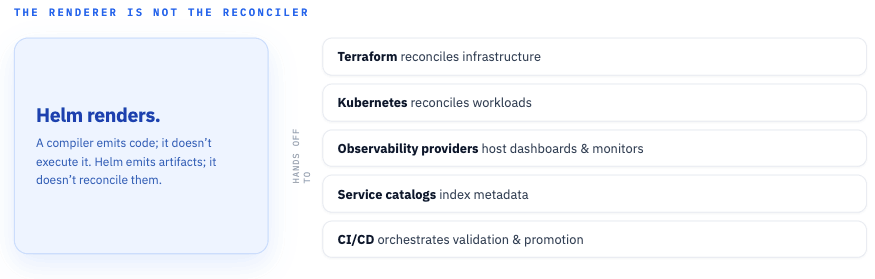
The renderer is not the reconciler: Helm emits, and each target system applies the convergence logic it is actually good at.
A compiler emits code; it doesn’t execute it. Helm emits artifacts; it doesn’t reconcile them. My own platform work runs through Argo CD, and this distinction is exactly why the pattern doesn’t fight GitOps: Argo reconciles the rendered manifests, Terraform reconciles the rendered HCL, and neither one knows or cares that the other exists. Each reconciler gets input in its native language and applies the convergence logic it’s genuinely good at. The renderer is not the reconciler — keep that boundary crisp and the architecture stays clean.
Keeping Helm in Its Lane
That boundary also answers the objection I’d raise if I were reading this series skeptically: “aren’t you just overloading Helm?”
No — and the compiler framing is why. The goal was never to force Helm to manage everything. The goal is to use Helm to render artifacts from metadata Helm already has. The lifecycle test from Part 1 still governs everything:
Good use:
Application-adjacent generated artifacts

Bad use:
Foundational cloud infrastructure
Cluster lifecycle
Global account architecture
Shared networking foundations
Your VPCs, clusters, and account structure have their own lifecycle and their own source of truth, and they should keep it. This is not “put all infrastructure in Helm.” It’s “compile the operational surface of a service from the service’s own model.” Helm’s lane turns out to be wider than we thought — but it’s still a lane.
The Platform Compiler Pipeline
Assemble every stage from this series and the mature pipeline reads like a compiler’s:
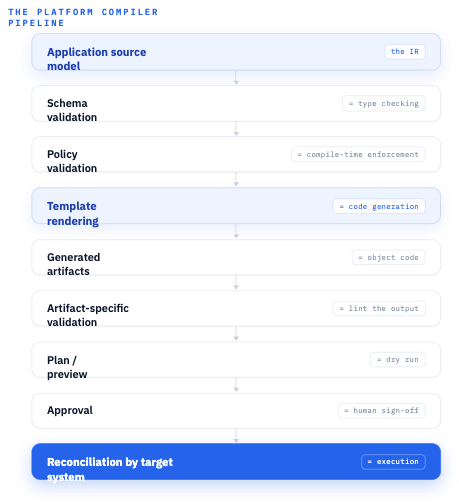
The platform compiler pipeline: predictable, testable, auditable — every stage has one job, every artifact one origin, and every failure an obvious address.
Predictable, testable, auditable — every stage has one job, every artifact has one origin, and every failure has an obvious address. Compare that to the status quo, where a service’s operational truth is smeared across five tools and the “pipeline” is a checklist in a wiki. The payoff isn’t any single generated dashboard. It’s that platform standardization, drift resistance, reviewability, provider portability, and fast onboarding all fall out of one architectural decision: model once, compile everywhere.
Where This Goes Next
I’ll level with you: Helm is the implementation this series used because it’s already sitting in your cluster and your team already speaks it. It is not the ceiling. Once you’re thinking in source models and backends, you can see the same architecture wearing other clothes — a dedicated service definition language, a CUE or Jsonnet schema with real type checking, a custom CRD that makes the model a first-class API object, a Crossplane composition layer, a Backstage-driven model, or a full internal developer platform SDK with the compiler at its core.
Some of those give you stronger validation than Go templates ever will. Some give you better ergonomics. All of them are the same idea: the architecture is bigger than Helm, and picking your renderer is a detail you can revisit later. The decision that matters is adopting the model.
The Series, in One Idea
If you remember one thing from these four articles, make it this: the future of platform engineering is not more disconnected YAML, HCL, dashboards, docs, and tickets — it’s a coherent application model that can generate the operational surface area around a service.
Terraform is still useful. Dashboards are still useful. Catalogs and runbooks are still useful. But none of them should maintain a private, slowly-rotting copy of what a service is.
The service should describe itself once. The platform should compile the rest.
If you want to try this, start embarrassingly small: pick one service, add owner and criticality to its values file, and write a single template that renders one Terraform module call for one synthetic monitor. Wire it into the pipeline from Part 2. That’s the whole seed — everything else in this series is that loop, repeated until your platform can finally answer questions about itself.
Enjoy!